

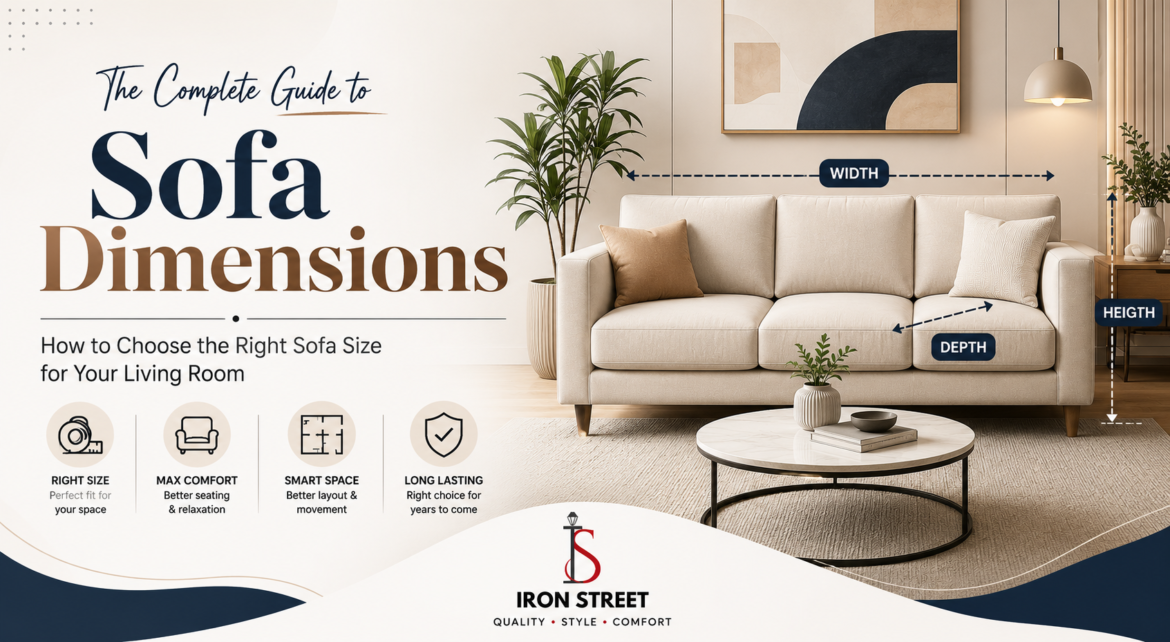
Sofa Dimensions Guide: How to Choose the Perfect Sofa Size for Your Living Room
| May 24, 2026Buying a sofa usually starts with a simple question: Will it actually fit in my living room?
The answer isn’t just about the length of the wall. A sofa’s width, depth, height, armrests and overall design all affect how much space it takes up. An L-shaped sofa needs even more attention because its second section extends into the room.
There isn’t one fixed standard sofa size. 2- and 3-seater sofas, for example, can have noticeably different dimensions depending on their frame, cushions and armrests.
This guide explains common sofa dimensions for single-seat, 2-seater, 3-seater, 4-seater and L-size sofas, along with measurements in centimetres, feet and inches. You’ll also learn how to measure your room and check whether a sofa will fit through your entrance before ordering.
Note: The measurements below are general planning ranges, not fixed industry standards. Actual dimensions vary by design and manufacturer, so always check the exact product measurements before buying.
Sofa Dimensions at a Glance
|
Sofa Type |
Approx. Width |
Approx. Width in Feet |
Typical Depth |
|
Single Seat |
75–100 cm |
2.5–3.3 ft |
75–90 cm |
|
2 Seater |
140–180 cm |
4.6–5.9 ft |
80–95 cm |
|
3 Seater |
180–240 cm |
5.9–7.9 ft |
85–100 cm |
|
4 Seater |
220–280 cm |
7.2–9.2 ft |
85–100 cm |
|
L-Size |
240–360+ cm* |
7.9–11.8+ ft* |
85–105 cm |
*L-size sofa dimensions vary considerably because the total footprint depends on the configuration.
For most buyers, the easiest numbers to remember are 140–180 cm for a 2-seater, 180–240 cm for a 3-seater and 220–280 cm for a 4-seater.
How to Read Sofa Measurements
When a sofa is listed as something like 210 × 90 × 85 cm, these measurements usually refer to its width, depth and height.
Width is the distance from one outside edge of the sofa to the other. This is the measurement you’ll mainly compare with the wall or area where the sofa will sit.
Depth tells you how far the sofa extends into the room, from the front edge to the back. This becomes particularly important in smaller living rooms.
Height is measured from the floor to the highest point of the sofa, usually the top of the backrest.
You may also see seat height and seat depth in detailed product specifications. These describe the seating area rather than the sofa’s complete footprint.
Furniture websites don’t always use “length” and “width” in the same way. When comparing products, the manufacturer’s dimension diagram should be your final reference.
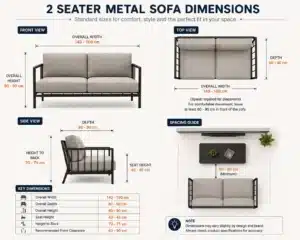
2 Seater Sofa Dimensions
A 2-seater is often a practical choice when space is limited. It works well in compact living rooms, apartments or rooms where you want to combine a sofa with an additional chair.
Most 2-seater sofa dimensions fall around 140–180 cm wide or approximately 4.6–5.9 feet. The depth is commonly around 80–95 cm. Don’t choose a 2-seater based on the seating capacity alone. Two sofas designed for two people can have different footprints because of variations in armrest width, cushions and frame construction.
If your room is narrow, pay particular attention to depth as well as width.
3 Seater Sofa Dimensions
The 3-seater sofa is one of the most versatile choices for a living room. It provides comfortable everyday seating without taking up as much space as a large sectional.
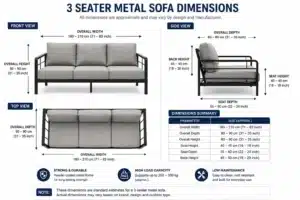
A common 3-seater sofa width is around 180–240 cm, which is approximately 5.9–7.9 feet or 71–94 inches. So, if you’re wondering about the 3-seater sofa size in feet, around 6–8 feet wide is a useful starting point.
However, don’t assume every 3-seater will be the same size. A slim contemporary design can be considerably different from a deep sofa with broad arms.
If you have an 8-foot wall, for example, an 8-foot sofa may leave very little room at either end. Consider what will sit beside the sofa and how people will move around it before using the entire wall.
L-Size Sofa Dimensions: What You Need to Measure
An L-size sofa is harder to measure than a straight sofa because it occupies space in two directions.
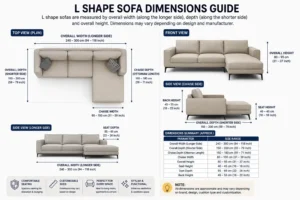
Instead of looking at just one length, measure the long section, short return, depth and height.
A typical L-size sofa design may have a long section of around 240–360 cm or more but there is much more variation than with straight sofas.
For example, an L-shaped sofa might have:
- Long section: 240–360+ cm
- Short section: approximately 140–200 cm
- Depth: around 85–105 cm
These are only general planning figures.
The short section is particularly important because it extends into the room. A sofa may fit perfectly along one wall but still block a doorway or leave too little space around a coffee table.
If you’re looking at an L-size sofa design, mark both sections on the floor with masking tape before buying. This gives you a much better idea of the actual footprint.
If the design includes a chaise, include the complete chaise extension when measuring.
Which Sofa Size Works Best for a Small Living Room?
The largest sofa that fits isn’t necessarily the right sofa for a small room.
A compact 2-seater can leave room for an additional chair or side table. A carefully sized 3-seater can also work well if the room has enough width.
Depth is often overlooked. A sofa that is only slightly wider than another model can take up considerably more floor space if it is deeper.
One simple trick is to use masking tape to mark the sofa’s approximate footprint on the floor. Leave the tape in place while you walk around the room and check the position of your coffee table, TV unit and other furniture.
If the layout feels cramped with tape on the floor, it will feel even more cramped once the sofa arrives.
How to Measure Your Living Room for a Sofa
Start with the space where you plan to place the sofa but don’t measure only the wall.
Check the available width and depth, then note anything that could affect the furniture layout, including doors, windows, pillars and built-in storage.
You should also consider the space between the sofa and other furniture. Around 40–50 cm between a sofa and coffee table is a useful starting point for comfortable access, although the ideal distance depends on the room.
For a main walking route, around 75–90 cm of clear space can make movement more comfortable.
These aren’t strict rules. A practical layout is one where people can move naturally without constantly having to squeeze between furniture.
Don’t Forget the Delivery Route
One of the easiest mistakes to make is measuring the living room but forgetting the route the sofa needs to take to get there.
Before ordering, check:
- Main entrance width
- Internal doorways
- Hallway width
- Staircase width and turns
- Lift entrance
- Tight corners
If the manufacturer provides packaged dimensions, check those as well.
This matters particularly with large 4-seaters and L-shaped sofas. The assembled sofa may fit your room perfectly but the packaged or assembled furniture still needs enough clearance to get through the building.
What to Consider When Buying a Metal Sofa
If you’re considering a metal sofa, the same basic measurements apply but the frame deserves a little more attention.
The frame, armrests and cushion construction can affect the sofa’s overall footprint. Two 3-seater sofas may offer similar seating but occupy different amounts of space.
When comparing metal sofa designs, look at the complete product dimensions rather than choosing only by the number of seats. Pay attention to the frame width, overall depth, seat depth and armrest projection.
This is particularly useful when choosing furniture for modern apartments, where every centimetre of floor space can matter.
For Iron Street, the exact product dimensions are the best reference when comparing metal sofa designs for your living room. Rather than choosing a sofa simply because it is labelled a 2-seater or 3-seater, compare its measurements with the space you have available.
Choose a Sofa That Fits Your Room
Sofa dimensions give you a starting point but the best choice isn’t simply the biggest sofa that fits against your wall.
Think about the sofa’s width, depth and complete footprint, then consider how people will move around it. For L-shaped designs, pay particular attention to the return or chaise because it can extend much further into the room than expected.
Before buying, measure the room, mark the proposed sofa footprint and check the delivery route. If you’re considering a metal sofa from Iron Street, compare the exact product dimensions with your available space before making your final choice.
A few minutes spent measuring can save you from ending up with a sofa that technically fits—but makes the entire room harder to use.
Frequently Asked Questions
What is the standard sofa size?
There is no single standard sofa size. As a general guide, 2-seaters are around 140–180 cm wide, 3-seaters around 180–240 cm and 4-seaters around 220–280 cm.
What are the standard 3-seater sofa dimensions?
A typical 3-seater is around 180–240 cm wide and approximately 85–100 cm deep.
What are 2-seater sofa dimensions?
A typical 2-seater is around 140–180 cm wide and 80–95 cm deep.
What are L sofa dimensions?
L sofa dimensions vary by configuration. Measure the long section, short return, depth and complete floor footprint before deciding whether it will fit.
How much space should be between a sofa and coffee table?
Around 40–50 cm is a useful starting point, although the ideal distance depends on the size and arrangement of your furniture.